
Mem0 alternatives: Mem0 vs Configure, and when to use each
Mem0 gives one agent a memory. Configure connects your agent to what a user’s other agents and apps already know, with a memory system built in.
Configure · · 6 min read
In short
- The main Mem0 alternatives are Configure, Zep, Letta, Supermemory and Cognee. They solve different problems, so start from your problem before you look at anyone’s benchmark.
- Mem0 stores what one agent learns, inside your account. Every new user starts empty.
- Configure is infrastructure for connecting agents, apps, and chats: users bring what ChatGPT, Claude, Gemini and their apps already know, and your agents read and write it with their approval.
- Choose Mem0 when you must self-host or have no end users. Choose Configure when real users arrive from other assistants, or several agents need to share what they know.
The main alternatives to Mem0 are Configure, Zep, Letta, Supermemory and Cognee. Configure is the least like it. Mem0 gives a single agent a memory inside your account, so every new user starts empty. Configure connects your product to the agents, apps and chats a user already has and comes with its own memory system, so your agent starts from what that user has already shared.
We build Configure, so read this page as our argument for it. We also say where Mem0 is the better choice. What we say about other products comes from their own pages, which we read on November 17, 2026 and link to.
How do Mem0 and Configure compare?
 Mem0 |  Configure | |
|---|---|---|
| A new user’s first session | Starts empty | Starts from what the user brings |
| Where knowledge comes from | Conversations your code sends it | Other assistants, connected apps, and your own agent’s conversations |
| Memory system included | Extract, search, update | Read, search, save, forget, extract from conversations |
| Shared across agents | Inside your account only | Any agent the user approves, including other companies’ |
| Who owns the memory | Your account | The user |
| Consent screen and profile page | You build them | Included and hosted |
| Connected app data | Not included | Gmail, Calendar, Drive, Notion |
| Works over MCP | Yes | Yes |
| Open source and self-hosting | Apache 2.0 | Hosted service |
Mem0 wins the last row outright, and for some teams that row settles it. The rows Configure wins are the ones a new user feels in their first five minutes.
What is Mem0?
Mem0 is memory infrastructure that a developer adds to an agent or app. Your code sends it conversations, it pulls out the facts, and on later turns it hands back the ones that are relevant. The core is open source under Apache 2.0, and there is a hosted platform on top. We think it is a good piece of engineering. It has a large community and it does what it says.
The limit comes from how it is designed. Memory is organized by the user ids your code supplies, and it belongs to your deployment. So Mem0 knows nothing about a person until your product has spent time with them.
What is Configure?
Configure is infrastructure for connecting agents, apps, and chats. Memory is one of the things that travels over that connection. A single integration gets you a page for your users and a memory system for your agents.
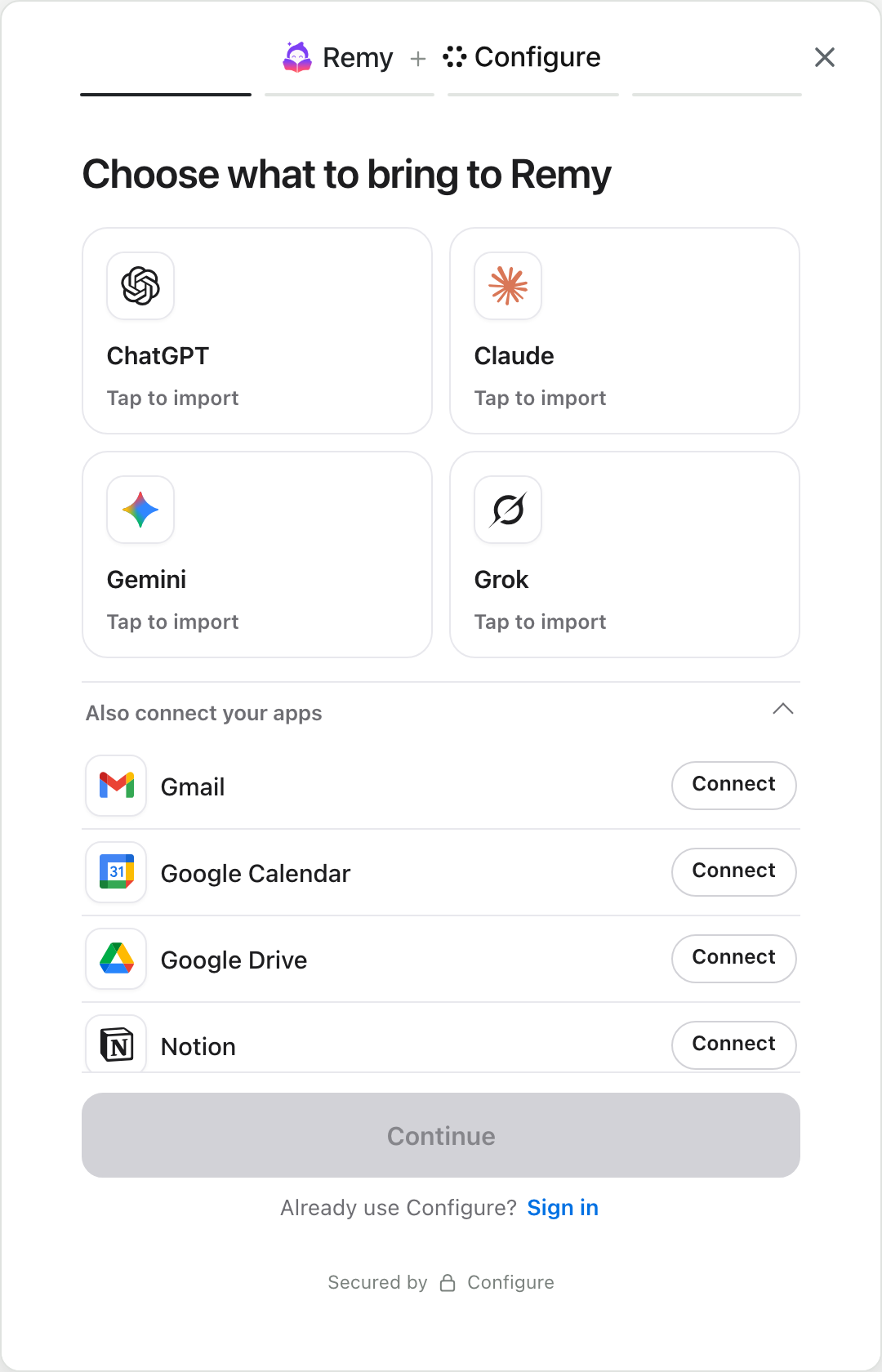
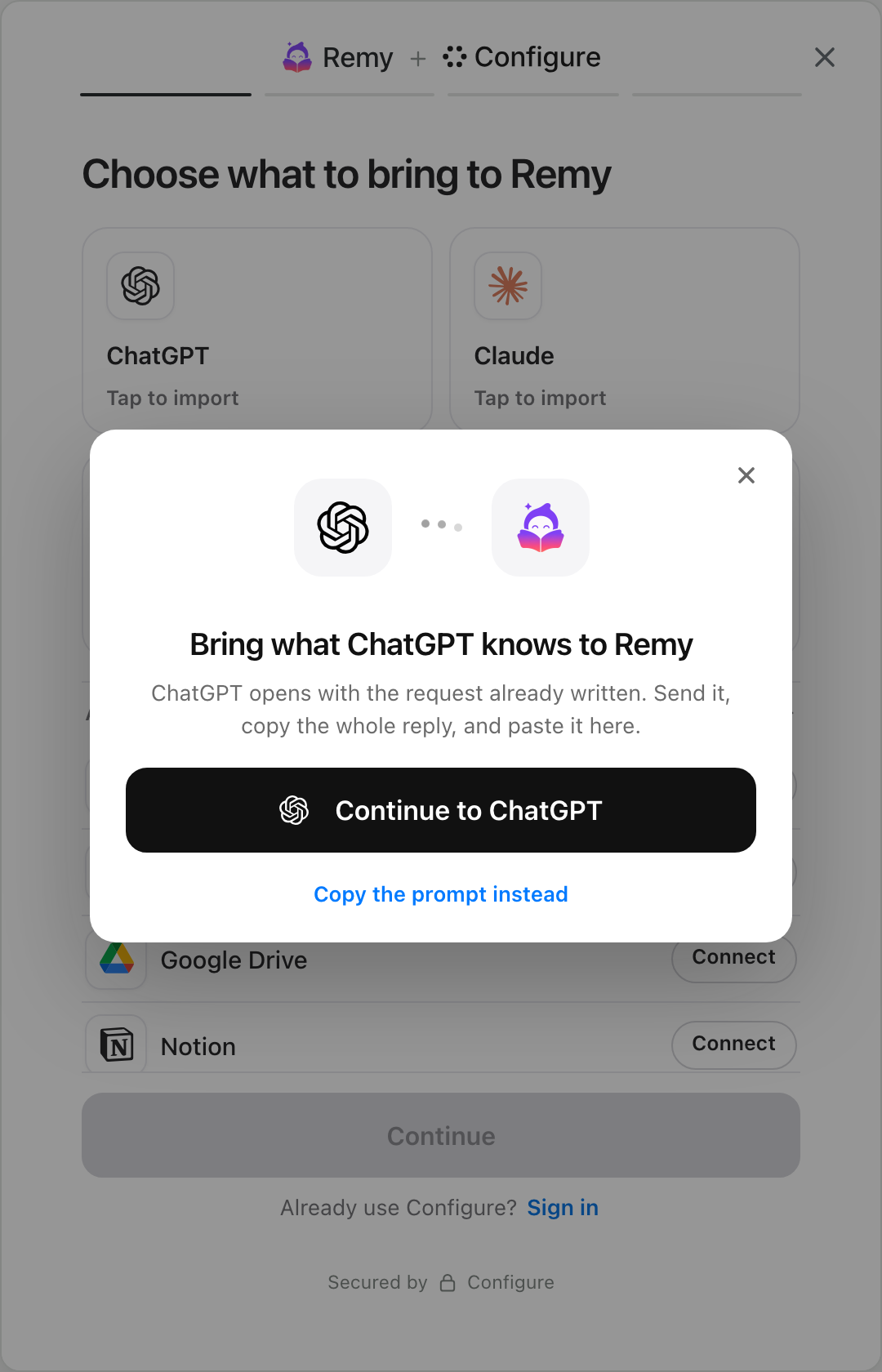
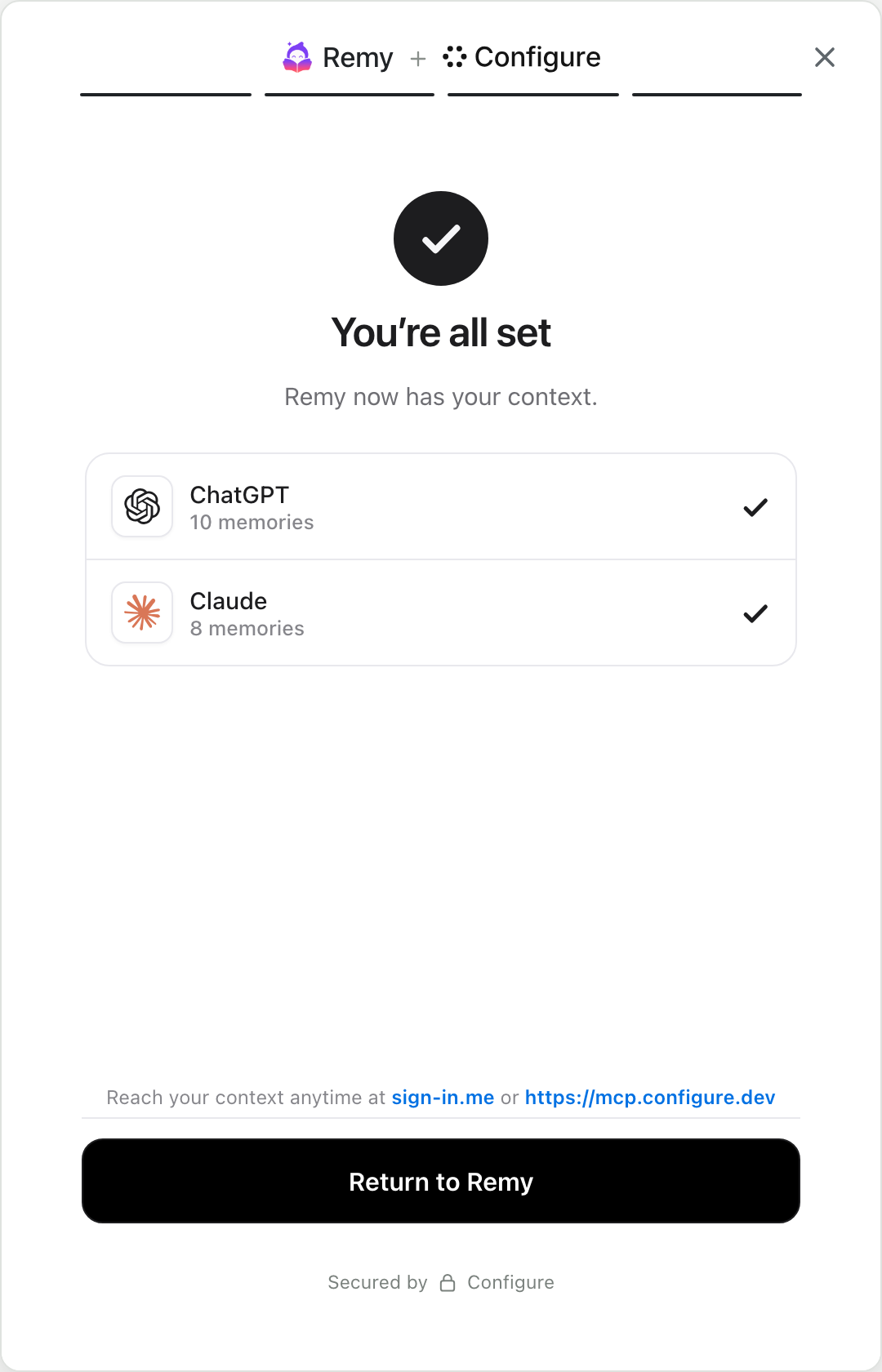
We host the page. A person uses it to bring in what ChatGPT, Claude, Gemini and Grok know about them, connect apps such as Gmail, Calendar, Drive and Notion, and approve your product.
The memory system is what your agents call. You read a user’s context before the first message and search it when a choice depends on a preference. You save what your agent learns, and you can extract memories from conversations. Each agent writes to its own namespace, and every read is checked against the user’s permissions.
What changes for a new user?
People judge an AI product in its first session, which is when it knows least about them. The model may be excellent, but with no knowledge of the person its first answers are the ones anyone would get. No memory library fixes that, however good its retrieval is, because there is nothing to retrieve yet. The knowledge does exist, in the user’s other assistants and apps. Configure is how your product reaches it, with their permission.
| With Mem0 | With Configure | |
|---|---|---|
| At sign-up | The user creates an account | The user creates an account and taps Connect |
| Before the first message | Your agent knows nothing about them | Your agent has what they brought from their assistants and apps |
| The first session | You ask onboarding questions | Your agent opens with their context |
| A month later | Memory of what happened in your product | The same, and it follows them to their other agents |
When should you choose Configure?
- Your users come to you from ChatGPT or Claude and have already explained their work somewhere else.
- You run more than one agent, or your agent works alongside other companies’ agents.
- You want users to see, edit and revoke what you hold, without building that page yourself.
- You need their calendar, mail and documents as well as their memory.
- You would rather not run memory infrastructure.
When is Mem0 the better choice?
- You must self-host, or you need the source code.
- Your agent has no end users. A back-office agent has nobody to bring context and nobody to ask for consent.
- You only need memory inside one agent, and nothing the user did elsewhere would help.
Check Mem0’s pricing page before you commit. It now lists a Free plan and a Custom plan. Graph memory, user profiles, single sign-on and on-premises deployment are all on Custom, and the price of Custom is not published.
Can you use Mem0 and Configure together?
Yes, and we think it is a sensible setup. Keep Mem0, or whatever you already run, as your agent’s working memory, and add Configure for the two things it cannot do: bring in what the user has on day one, and let that follow them to other agents. In practice you read the user’s Configure context at the start of a session and put it in front of the model. When your agent learns something lasting about the person, you save it to their profile as well.
Configure also stores and retrieves what your agent learns, so once it is in you may find you no longer need the second system. You can decide that later.
What are the other Mem0 alternatives?
| Product | What it focuses on | Where memory lives | Best for |
|---|---|---|---|
| Configure | Connecting your product to a user’s other agents, apps and chats | A profile the user owns | Products with real users arriving from other assistants |
| Mem0 | A memory API that extracts facts from conversations | Your account | One agent that needs memory quickly, or a self-hosted setup |
| Zep | A temporal knowledge graph, where every fact has the dates it was true | Your account | Facts that change over time |
| Letta | A runtime for agents that manage their own memory | Your account, or local | Long-lived autonomous agents |
 Supermemory | Memory and document search behind one API | Your account | Apps that need files and memories searched together |
| Cognee | A knowledge graph built from your documents | Your account, or self-hosted | Reasoning across a body of documents |
Zep’s paid plans start at $125 a month. Supermemory’s clients are open source, but its docs confirm the server source is not public. OpenMemory, Mem0’s local product, was sunset in 2026 and its addresses now redirect to Mem0.
We have left benchmark scores out of this page. Most vendors publish scores on which they come first, and several dispute each other in public. Zep, for one, wrote a detailed rebuttal of Mem0’s paper. Before you believe a chart, run your own conversations through two candidates.
Frequently asked questions
What is the best alternative to Mem0?
It depends on what you are missing. If your agent meets real users, we would pick Configure, because it is the one on this list built to start a new user with context and to let memory move between agents. For time-aware facts, look at Zep. For a self-managing agent, look at Letta.
Is Mem0 open source?
The core library is, under Apache 2.0. Several features, including graph memory on the hosted platform, are on its Custom plan.
Does Configure replace Mem0?
It can. Configure stores, searches and extracts memories for your agents. It also does two things Mem0 does not. It brings in what the user already shared elsewhere, and it lets the user own that memory and move it.
How long does Configure take to add?
It is one integration. You put a connect button in your product, the user goes through Configure’s hosted page, and your agent reads their context on the first turn. The quickstart covers it on one page, and the trust page explains the permission model. We wrote more about the first-session problem in The cold start problem in AI apps.
Add a connect button to your product
The quickstart takes one page, end to end: a chip in your app, Configure's hosted page, and your agent reading the user's context on the first turn.
Read the quickstartAbout Configure. Configure is infrastructure for connecting agents, apps, and chats. People bring the context they already have, and the products they approve start from it. More about Configure.
More from the blog
All postsSupermemory alternatives: Supermemory vs Configure
Supermemory gives your app a memory and document store. Configure connects your app to what a user’s other agents and apps already know.

MemoryPlugin alternatives: MemoryPlugin vs Configure
MemoryPlugin adds a memory to the AI sites you visit. Configure connects your assistants, your apps and the products you sign up for.





Which AI has the best memory? Six assistants compared
Every assistant remembers you now, and each one remembers a different slice. We compare six of them, then show how to use them all with one memory.